9 Macro Forces That Threaten The Independent School Model
The Real Challenge Facing Independent Schools Isn’t One Trend. It’s the Collision of Nine.
For years, leaders in independent schools have heard warnings about the coming “enrollment cliff.” The phrase has become shorthand for demographic decline, shrinking birthrates, and a smaller pool of school-age children.
But the enrollment cliff isn’t really a cliff and, by itself, is not the real story. The real story is convergence.
Independent schools today are not facing a single disruptive force. They are facing multiple macro forces simultaneously - economic, demographic, cultural, technological, and competitive forces that are reshaping the educational landscape in real time. The challenge is not simply that one thing is changing. It is that everything is changing at once.
Trend #1: Millennial Families Have Changed the Consumer Mindset
Today’s independent school parent is fundamentally different from the parent of twenty years ago. We’ve heard this story many times. Millennial families tend to approach education with stronger expectations for measurable value, flexibility, transparency, and return on investment. Prestige and tradition alone no longer carry the persuasive power they once did.
These families are also financially different. Millennials often carry more debt and possess less generational wealth than prior generations at the same life stage. They are having fewer children, which shrinks the total addressable market for schools.
Most importantly, loyalty has changed. Enrollment is no longer assumed. Re-enrollment is now an annual referendum on value.
Parents increasingly ask:
• What outcomes justify this tuition?
• Is this school differentiated enough?
• Could my child receive something similar elsewhere for less?
• Is there a better-fit specialized option?
This shift toward a more transactional educational marketplace changes everything - from admissions messaging to retention strategies to pricing models. For what it's worth, I applaud this increased scrutiny. It can only force independent schools to evolve in ways that may be painful, but will ultimately make schools stronger and more relevant.
Trend #2: The Teacher Workforce Is Under Extraordinary Pressure
Independent schools have long depended on talented educators, often willing to accept lower compensation in exchange for mission, autonomy, and community. That social contract is weakening. Teaching salaries remain significantly below comparable professions, and fewer young adults are entering the field. Nationally, teacher shortages continue to affect schools across sectors. At the same time, younger generations entering the workforce expect flexibility, professional growth, mental health support, and sustainable workloads.
Independent schools now face a difficult tension:
• Families expect more personalization, communication, and support than ever before.
• Schools need extraordinary educators to deliver that experience.
• But the workforce pipeline is shrinking while burnout is rising.
Many schools were built on a faculty culture and financial model that assumed long hours, deep institutional loyalty, and personal sacrifice. That model is becoming increasingly difficult to sustain.
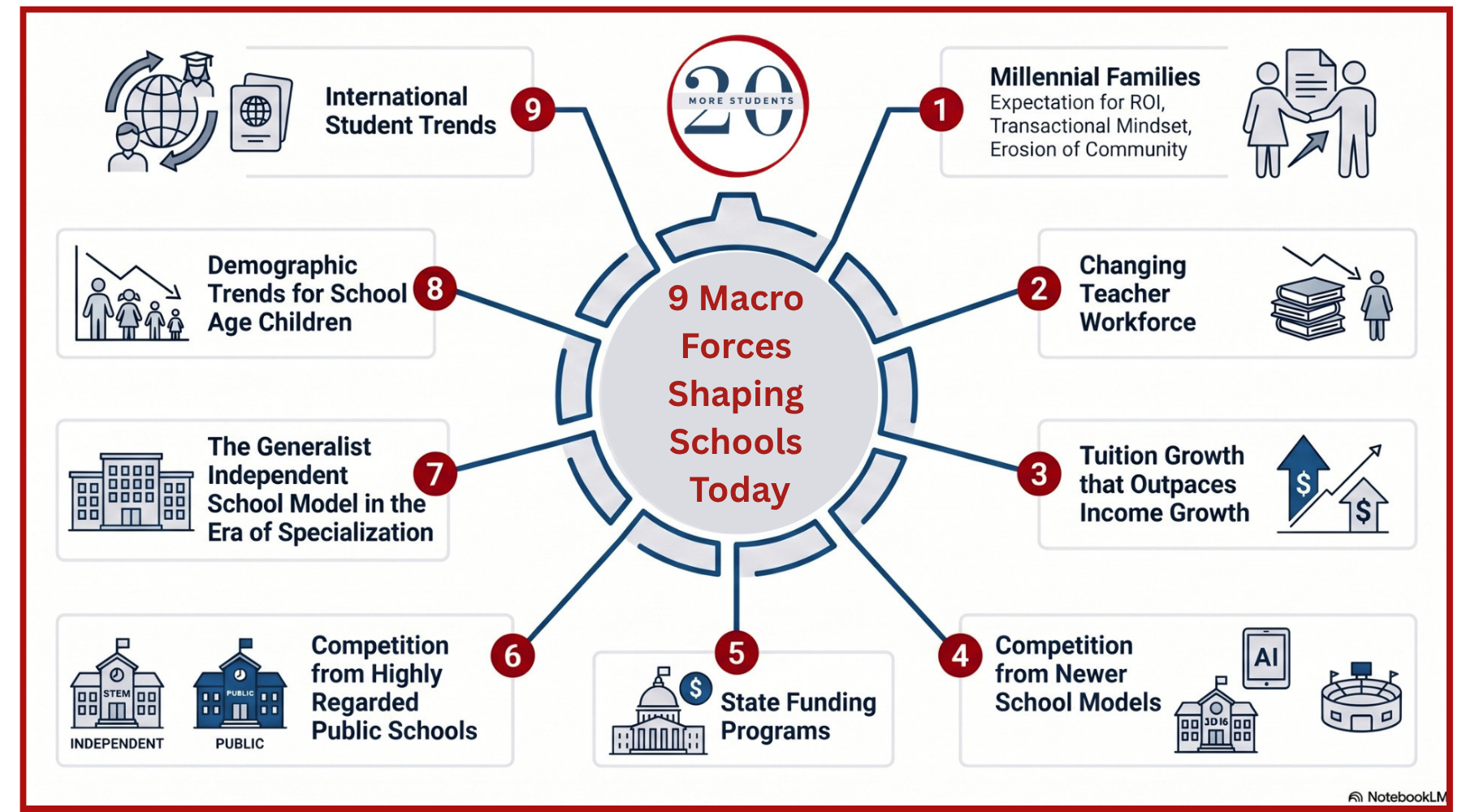
Trend #3: Tuition Growth Has Outpaced Income Growth
This may be the most existential force of all. For decades, many independent schools relied on annual tuition increases to balance budgets and fund program expansion and, in many cases, a facilities arms race. But tuition has long outpaced income growth for many families, particularly outside the wealthiest households. According to NAIS-related affordability analysis, a family may need a household income approaching $280,000 annually to afford tuition for one child at many high-priced independent schools.
The result is a growing affordability squeeze:
• Middle-income families were long ago priced out.
• Financial aid budgets are ballooning.
• Discount rates continue to rise.
• Schools are increasingly competing for the same limited pool of affluent families.
This is not merely a pricing issue. It is a market-size issue.
This trend is not new, and many will say, “So, we’ve been talking about tuition increases for years.” Here’s the difference. This one macro trend is now one of nine such forces, many of which may only get stronger in the years ahead.
Trend#4: New School Models Are Emerging Rapidly
The definition of “school” is changing. Microschools, hybrid schools, online academies, AI-driven learning environments, public magnet schools, and specialized niche schools are proliferating rapidly. Parents increasingly see education as customizable rather than standardized. Whether directly or indirectly, each of these models expands school choice and threatens independent schools.
Trend#5: State Funding Programs Are Expanding
School choice legislation continues to grow across the country. For some schools, these programs create opportunity. For others, they create entirely new competitive dynamics. They also create the risk of what might come - mandated testing? mandated curriculum? This is one area where we are in the land of the unknown. With 1.3 million students now enrolled in private schools using school vouchers, Education Savings Accounts (ESAs), tax-credit scholarships, and refundable tax credits, the full impact of these programs is yet to be understood.
Trend #6: Strong Public Schools Have Become Serious Competitors
Selective magnet programs, STEM academies, International Baccalaureate schools, governor’s schools, and highly ranked suburban districts now provide compelling academic alternatives at little or no direct cost to families. Independent schools can no longer assume that families dissatisfied with public education will naturally migrate toward private education.
Trend #7: The Era of Specialization Is Challenging the Generalist Model
The market increasingly rewards specialization. Families are becoming accustomed to specialized everything - healthcare, media, technology, entertainment, fitness, and professional services. Education is following the same trajectory. Yet, independent schools still, for the most part, cling to a generalist approach to education and struggle to demonstrate return on investment in the ways families expect today.
Trend #8: Demographic Decline Is Real, and Long-Term
Birthrates in the United States have declined significantly over the past two decades. NCES projections indicate continued enrollment decline in the coming years, with long-term forecasts suggesting there will be about 5 million fewer school-age children in the US by the end of the decline. The challenge is not simply fewer children. It is fewer children combined with more competition, higher costs, and changing consumer behavior.
Trend #9: International Enrollment Could Become Less Predictable
Many independent schools, especially boarding schools, have increasingly relied on international enrollment to stabilize enrollment and revenue. But geopolitical instability, visa uncertainty, global economic fluctuations, and increased competition for international students have made that pipeline less predictable. Whether that stability returns remains to be seen. Even if it does, will international students still feel compelled to study in the US at numbers seen a few years ago?
These forces present a significant risk,
but the greatest risk is denial.
None of these forces alone guarantees institutional decline. But together, they create enormous pressure on schools built for a very different era. The greatest danger for independent schools is not that these forces exist. It is pretending that they do not fundamentally alter the strategic landscape.
The schools that thrive will be the ones willing to adapt. Yes, independent schools still possess extraordinary strengths - deep relationships, mission-driven cultures, robust communities, strong educational outcomes, and the potential to innovate faster than many larger systems.
But thriving in the next decade will require independent schools to fulfill that potential. Doing so will require that they be driven by adaptive thinking rather than preservation thinking. Because of that, the schools that survive this era will not necessarily be the oldest, wealthiest, or most prestigious. They will be the ones most willing to face reality clearly and evolve accordingly.
